
 +44 1744 734123
 info@plastech-controls.com
 Navigation
Single- or multi-head conveyor fed machine for high speed bottle leak detection.
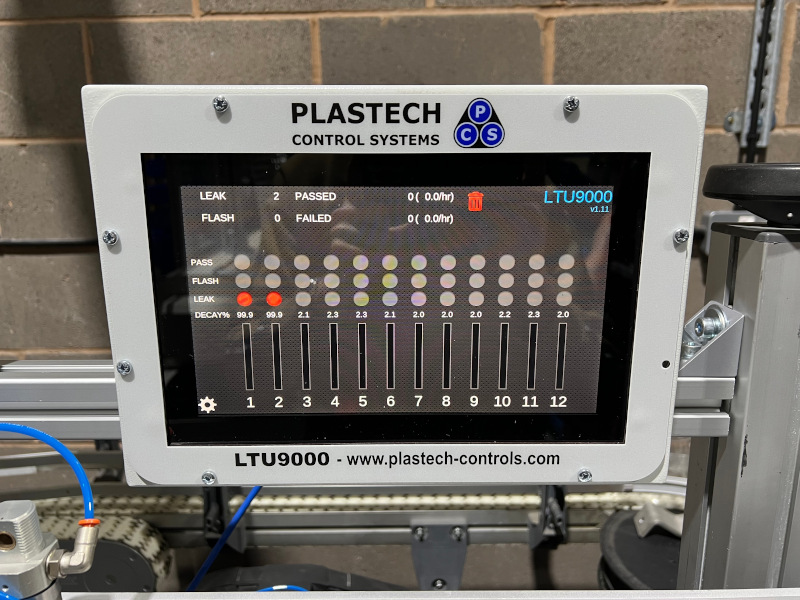 12-channel LTU9000 testing bottles in line.
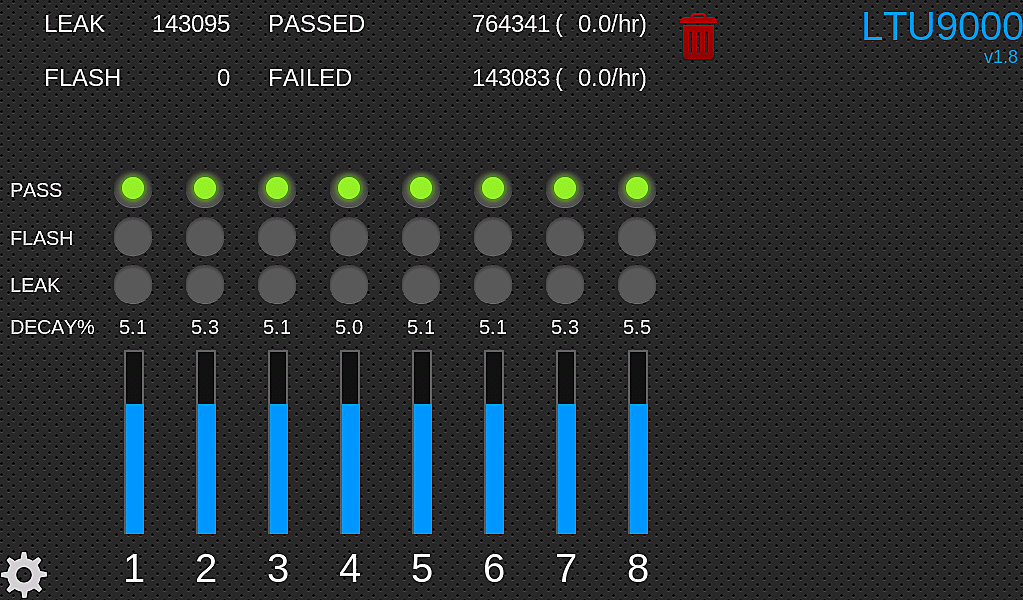 Main Screen
 General Description
The LTU9000 leak detector is an in-line bottle leak detection system capable of testing from 1 to 12 bottles at a time, with throughput up to 240 bottles per minute depending on the number of test channels fitted. It is an evolution of the LTU5000, updated with a new touch-screen control system and all-new electronics.
Its intended use is for 100% leak testing of the output of a blow molding machine. Several options are available which allow the system to perform a variety of important additional operations on the bottles.
Its reliability, accuracy, flexibility and high speed of operation make it an extremely cost effective alternative to expensive rotary leak testers. No “change parts” are required.
Features
The LTU9000 series of leak testers have many advanced features:
High accuracy leakage measurement
Measurement errors are minimized through the use of a sensitive pressure transducer with a low noise amplifier and a high speed, high resolution analog to digital converter.
Touch-Screen Microprocessor control system
New technologies make the touch-screen a far more efficient and cost effective means of interfacing with the system than the older, plain digital readouts. Some of their many advantages are:
- User friendly, intuitive operation.
- Extremely flexible design. Extra features and customizations can be easily integrated into existing systems.
- All test results, displays and counts are displayed together on the main Displays page. This enables evaluation of the status of the system at a glance.
- All settings are grouped together on a Settings page, allowing easy inspection and modification.
- All input and output states are displayed together on a Diagnostics page. This allows quick fault finding.
- Simple RJ45 cable connection to the touch panel avoids complex and messy connectors.
- Setting changes can be locked out if required.
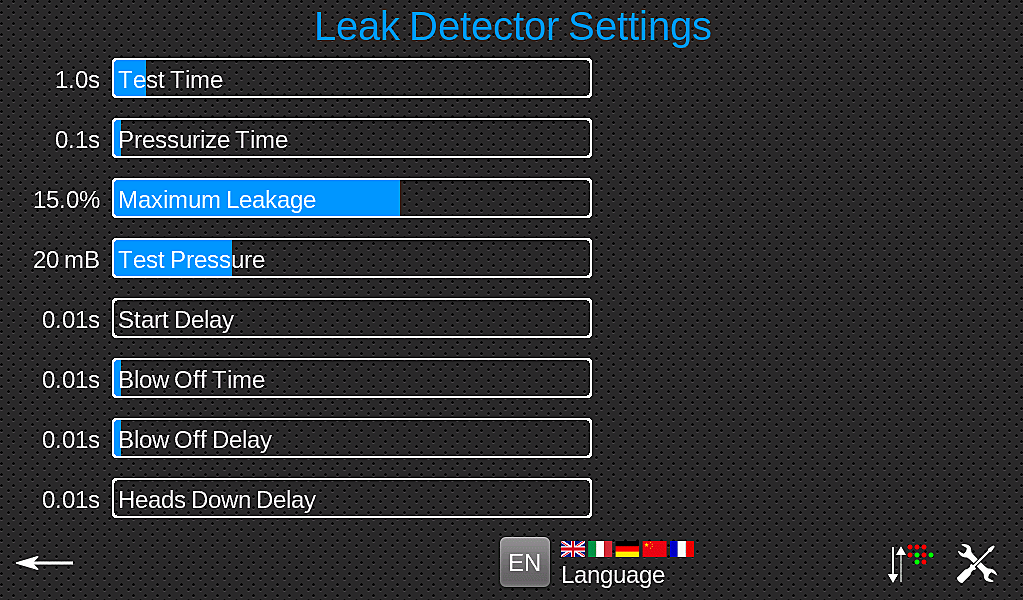 Settings Screen
High Reliability
Advanced technologies reduce the number and complexity of internal components. An in-depth understanding of failure mechanisms, coupled with the integration of all electronic functions onto the PCB, assures that the LTU9000 meets only the highest standards of reliability.
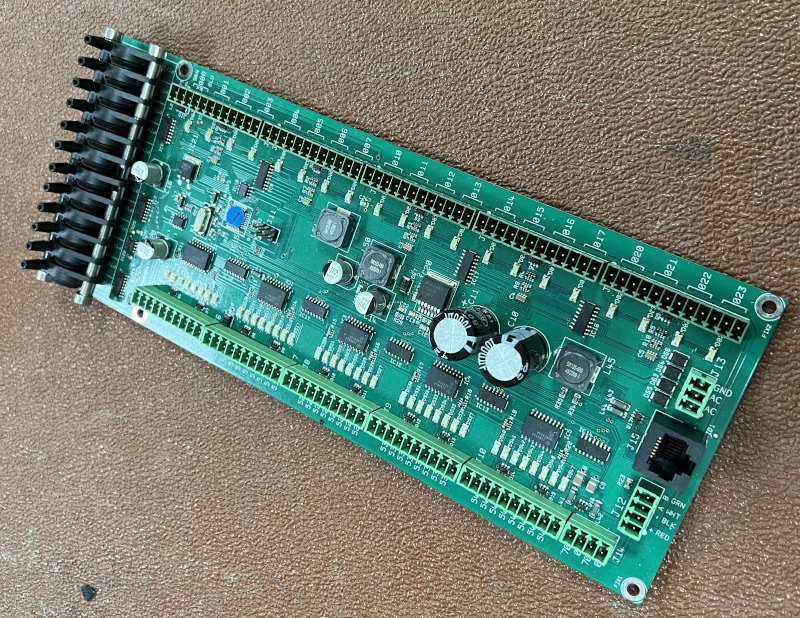 All electrical functions integrated onto the PCB
Modular pneumatic system
Modular design allows quick, flexible customization of the LTU9000 system to meet special needs and facilitate easier expansion even after installation.
Flexible bottle transport system
Timings can always be easily adjusted to maintain optimum bottle transport, without sacrificing test time.
Cost Effective
The LTU9000 circuit cards have been designed and programmed specifically for flexibility. Great care has been taken to ensure that the system is easily re-programmable and expandable. This means that the performance and cost limitations of using a bought-in Programmable Logic Controller are avoided.
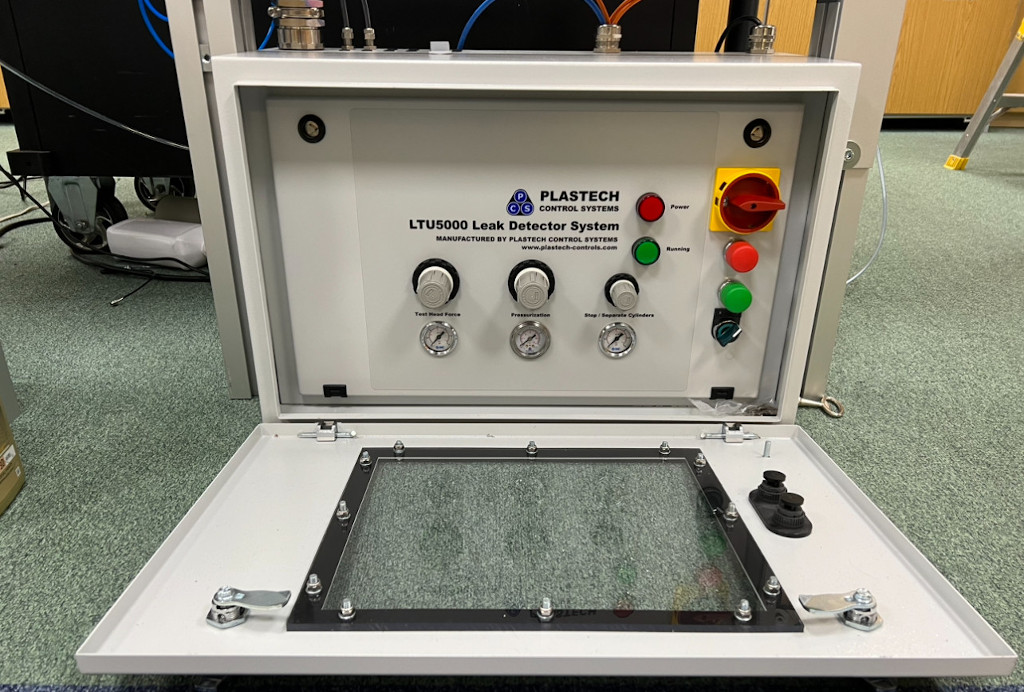 LTU9000 control cabinet
Options
Several options are available to allow the system to perform a variety of important additional bottle operations:
- Choked Bore / Ovality Test
- Flash Detection
- Fallen Bottle Rejection
- Batch Counter / Diverter
- Data Logging / SPC
- Wall Thickness Measurement
- Collating Table Control
- Bottle Orientation
- Angled Neck Bottle Testing
For more details on any option, contact the office or refer to the product manual.
Specification
| Hole Size Detected / Throughput | 0.1 mm / 140 bottles per minute / 8 heads. See Performance Graphs for details. |
| Number of Test Channels | 1, 2, 3, 4, 6, 8, 10, 12 (specify when ordering) |
| Leak Test Method | Ratiometric Pressure Decay, Auto-zero, Auto-Scale. Adaptive pressurisation algorithm. |
| Electrical Power Supply | 110/120 or 220/240 VAC single phase |
| Power Consumption | 50 VA maximum (excludes conveyor) |
| Air Supply | 60-150 psi (4-10 bar) |
| Air Consumption | 1 litre per minute typical |
| Minimum Bottle Volume | 250 cc |
| Maximum Bottle Volume | 10 litres (2 gallons) |
| Test Pressure | Adjustable, 0.15 - 0.6 psi (10 - 40 mB) |
| Cycle Time | 1.0 - 20.0 seconds, adjustable |
| Transducer | Semiconductor strain gauge diaphragm, 0.00 - 65.00 mB, 0.02% resolution, x20 Over-pressure Protection. |
Ordering Information
The LTU9000 is available complete including conveyor system, or alternatively as a kit for system integrators or for fitting to an existing customer conveyor. The system can be fitted with between 1 and 12 channels of leak detection plus the options listed above.
Performance Graphs
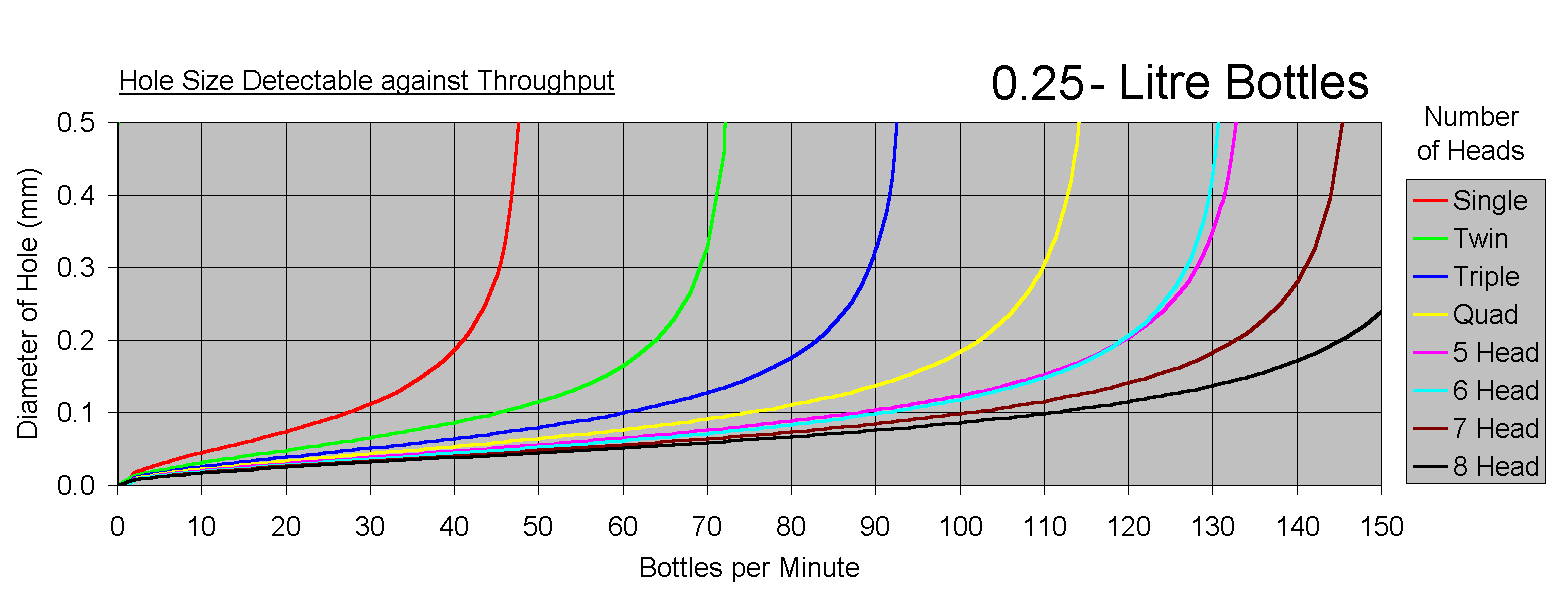
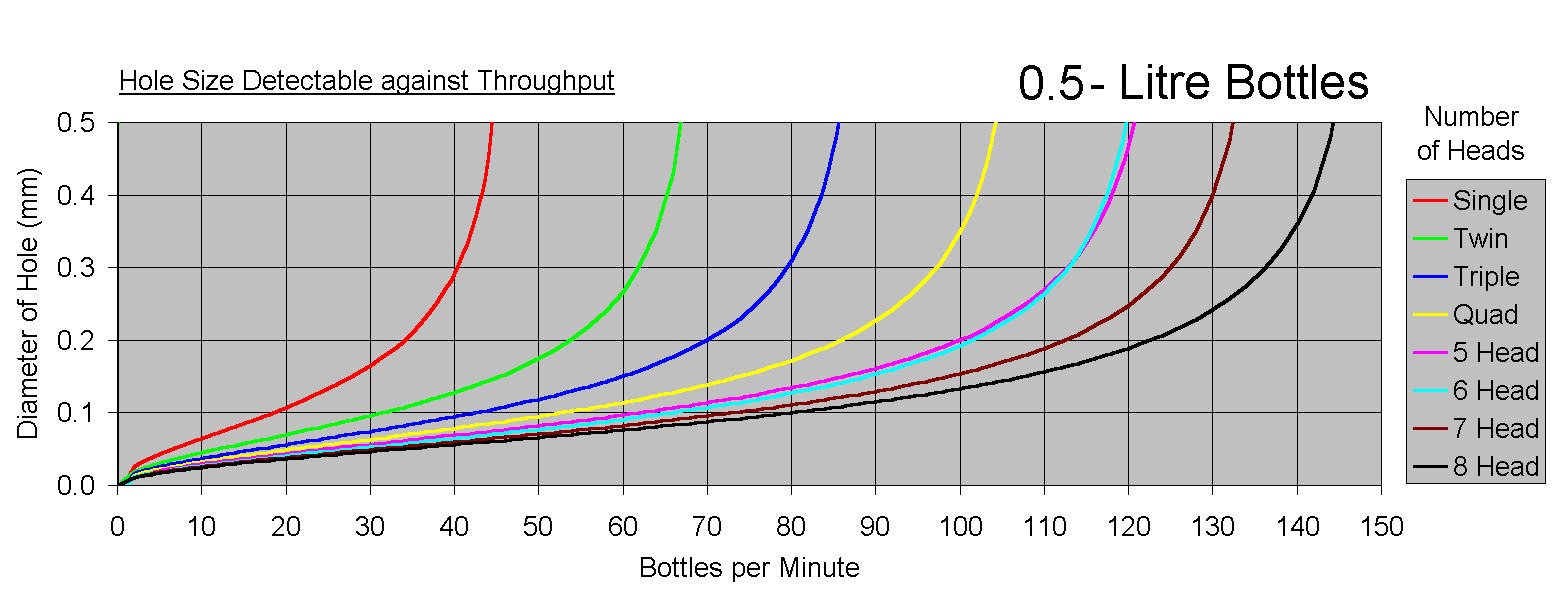
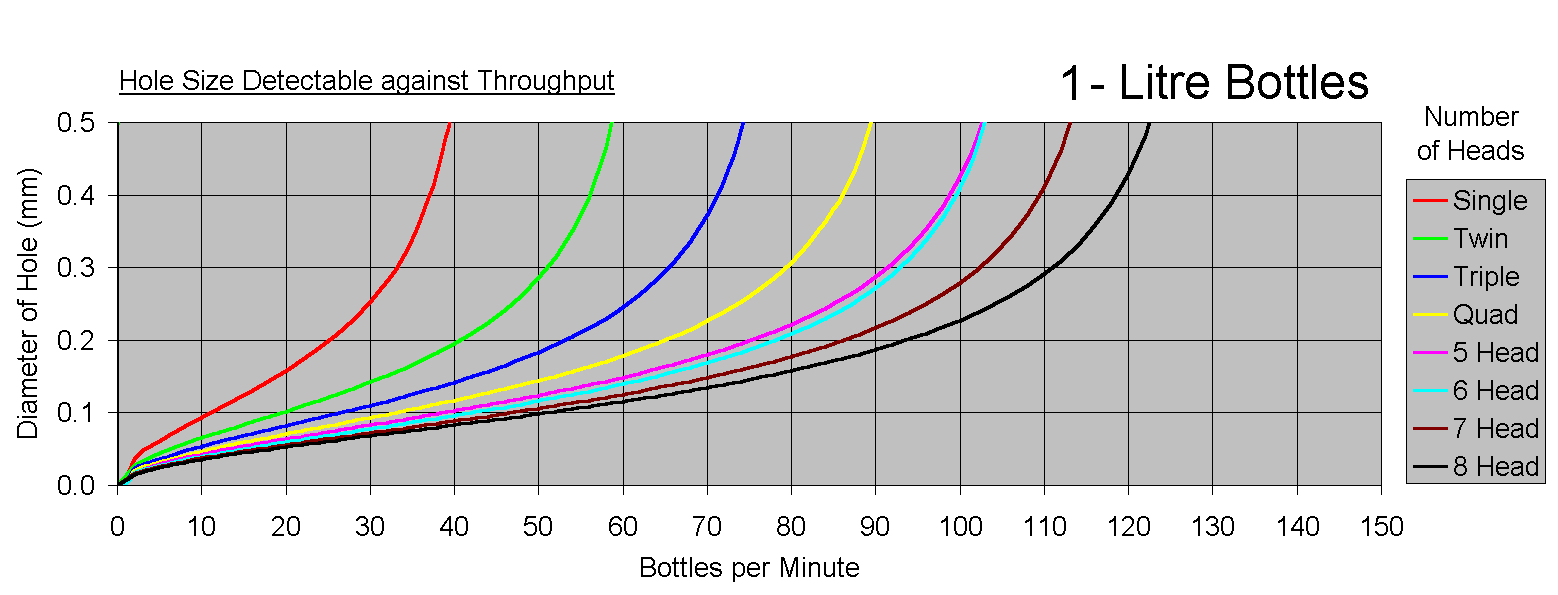
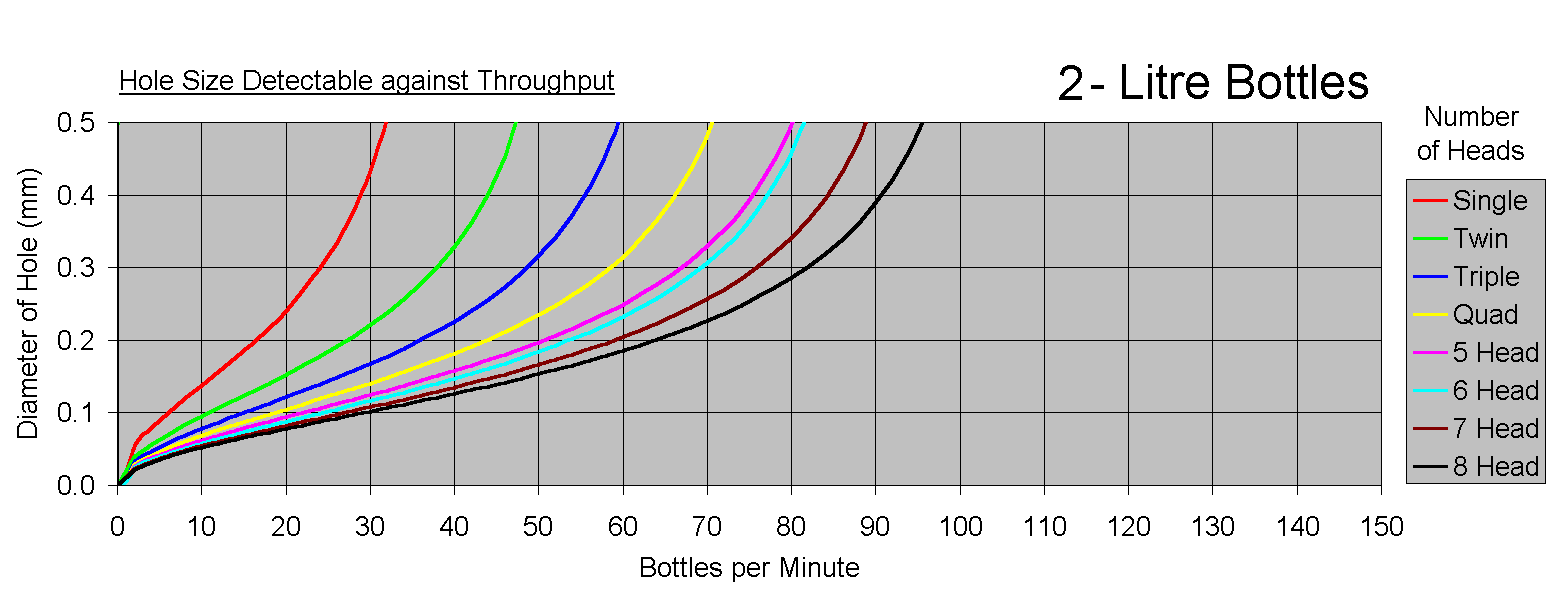
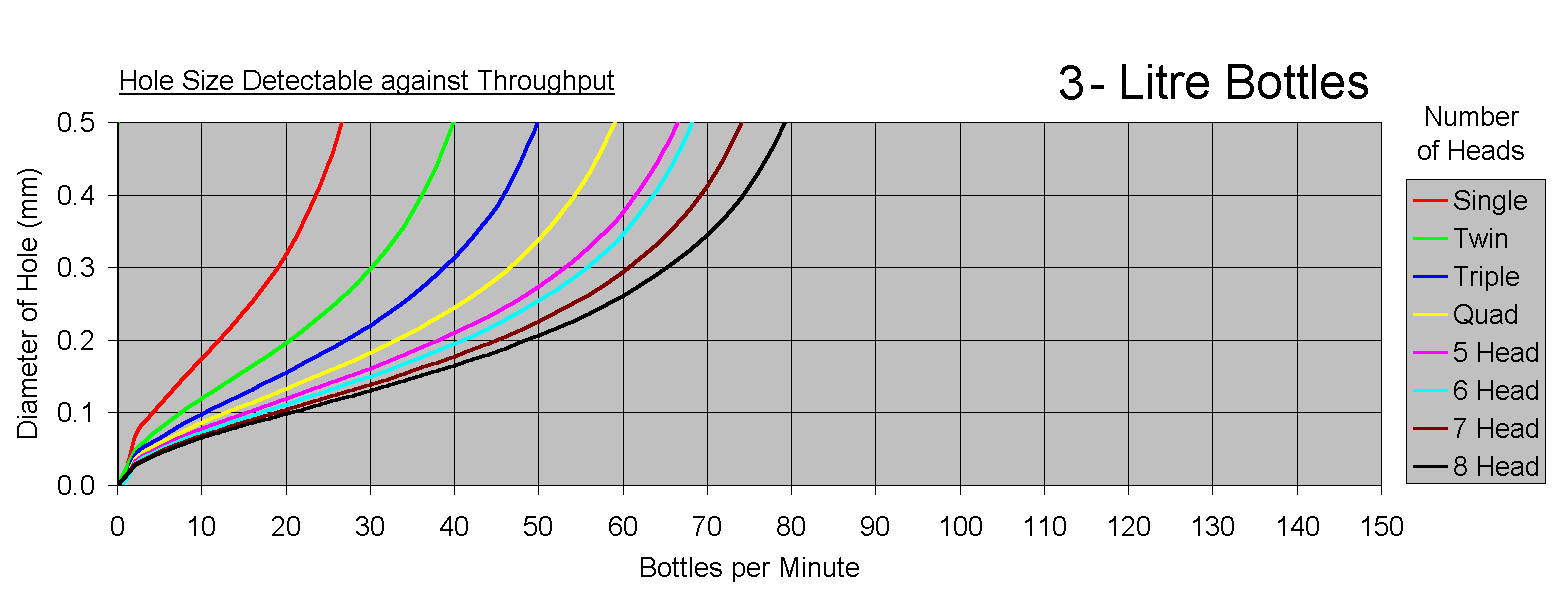
Following are performance graphs showing the sensitivity (hole size detected) of the system for a range of bottle sizes. Each graph shows performance for a particular bottle size, and each model (single, twin, triple channel etc) has a line on the graph.
To use the graphs, first choose the graph nearest to the bottle size of interest (shown at the bottom). Find a colored line where the required hole size and throughput intersect. Read off the number of heads required from the key on the right of the graph. Contact the office if in doubt.
The graphs shown are all for a single in line conveyor configuration. For a dual in line conveyor system, use half of the total throughput required to select the number of heads per side, e.g. for a 250 bottle per minute system, use 125 BPM to select the number of heads per side.
Remember to allow a margin of speed to allow the leak tester to catch up with the machine after a stoppage, or when manually feeding extra bottles onto the conveyor.
Notes on Performance Graphs
The graphs above are based on real-life figures as measured on a wide range of installations, machine configurations and bottle types. This data has been used to create a mathematical model which produced the smooth lines above (instead of a series of measured data points). Realistic values are assumed for the variables involved (conveyor speed, bottle dimensions, bottle stretch characteristics, leak tester accuracy). The sensitivity shown is conservative. However, it is possible that a particular application will encounter different values for these. For example, an unstable bottle may require a slower conveyor. We suggest that you contact the office before specifying a particular model of leak tester so that we can take all parameters into account.

 +44 1744 734123
 info@plastech-controls.com

